


Syllabus: GS3/Economy
In News
- The Union Cabinet has approved ‘Samudra Manthan’ – the National Offshore Exploration Scheme with an approved outlay of Rs.84,084 crore for implementation up to FY 2030–31.
Offshore Exploration
- Offshore exploration is the search for natural resources, primarily crude oil, natural gas and seabed minerals, that lie beneath the ocean floor.
- It requires complex geological, geophysical and engineering methods to locate and evaluate potential reserves hidden beneath marine waters, before commercial drilling or extraction.
Benefits of Offshore Exploration
- Energy Security: Tapping offshore reserves enhances national self-reliance, reducing vulnerability to global geopolitical conflicts, supply chain shocks, and volatile crude prices.
- Economic Growth: Major offshore projects generate large amounts of Foreign Direct Investment (FDI), create jobs requiring high skills, and generate large amounts of government revenues through royalties, taxes, and corporate profits.
- Great Untapped Potential: Offshore basins harbour large quantities of the world’s undiscovered hydrocarbon reserves and rare-earth minerals on the seabed.
- Technological advances: Offshore activities stimulate technological advances in subsea engineering, robotics, seismic imaging and maritime logistics, spurring domestic manufacturing and ancillary service sectors.
- Transition: Offshore natural gas discovery offers a cleaner-burning transition fuel to bridge the gap between heavy fossil fuels and zero-emission renewable energy systems
Challenges
- Financial Risk: Deep water drilling requires multi-billion dollar up-front investments, long lead times, and has a high risk of ‘dry wells’ in the early stages of exploratory drilling.
- Technology challenges: High pressure, low temperature and ultra-deep environments require state-of-the-art technology, specialised drilling rigs, and complex subsea architecture.
- Environmental Risks: Marine ecosystems face threats from seismic surveys, discharges of waste, noise pollution underwater and the very real risk of marine oil spills.
- Geopolitical disputes: Offshore basins frequently overlap disputed Exclusive Economic Zones (EEZs), maritime boundaries and defense-sensitive “no-go” zones.
- Energy Transition Dynamics: The global transition to renewables poses long-term demand uncertainty, making private investors hesitant to lock up capital in offshore projects that last decades.
Governments steps
- ‘Samudra Manthan’ Scheme: It is a Central Sector Scheme of the Ministry of Petroleum & Natural Gas
- It is inspired by the vision of unlocking India’s offshore energy potential and aims to strengthen energy security and support the goal of Viksit Bharat.
- Components
- Acquisition and processing of modern offshore seismic data with an outlay of ₹28,534 crore;
- Drilling of 60 deepwater exploration wells with an allocation of ₹43,200 crore, including Government support of up to 50% of eligible drilling cost or ₹675 crore per well, whichever is lower
- Development of common offshore infrastructure hubs with an outlay of ₹10,000 crore to facilitate commercialisation of discoveries; and
- Establishment of Oil and Gas Manufacturing and Services Zones with an outlay of ₹2,000 crore to promote domestic manufacturing and localisation of critical equipment and services
- Objectives: It aims to enhance India’s energy security by unlocking over 600 Million Metric Tons of Oil Equivalent (MMTOE) of offshore reserves, boosting domestic oil and gas output
- It aims to decrease import reliance, generate employment, attract investments, and bolster Make in India via indigenous offshore technologies.
- It will build a globally competitive energy ecosystem and aid India’s long-term economic growth.
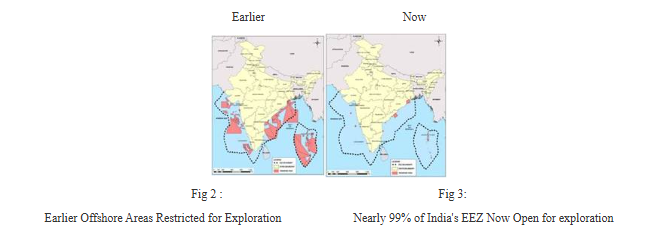
- Opening Up Offshore Acreage: More than 99% of the earlier “No-Go” areas have been removed, making over one million square kilometres of India’s Exclusive Economic Zone available for exploration for the first time.
- Modernising the Contractual Regime: India transitioned from Production Sharing Contracts to Revenue Sharing Contracts, simplifying the fiscal framework and improving transparency while reducing administrative intervention.
- Legislative Reforms: The Oilfields (Regulation and Development) Amendment Act, 2025 modernised the legal framework governing the sector by providing contractual stability, recognising integrated petroleum operations, strengthening dispute resolution mechanisms, and establishing a contemporary regulatory architecture.
- Implementation Through New Rules: The Petroleum and Natural Gas Rules, 2025 operationalised these reforms by promoting ease of doing business, improving regulatory efficiency, and streamlining the administration of petroleum leases.
- Uniform Decision-Making Framework: The Government has also standardised the composition and mandate of the Empowered Committee of Secretaries across all contract regimes, ensuring consistency and a level playing field for all operators, irrespective of when their contracts were signed.
- Sharper Focus on Exploration: The performance parameters of ONGC and Oil India have been reoriented to place greater emphasis on exploration activities, reinforcing the Government’s commitment to expanding India’s domestic hydrocarbon resource base.
Conclusion
- Offshore exploration is a strategic pillar of India’s energy security and economic development as it underpins the discovery of domestic resources and reduces dependence on imports.
- The Samudra Manthan initiative aims to promote exploration-led growth through risk-sharing support and advanced technology and investment incentives for deepwater hydrocarbon exploration in the frontier basins of Krishna-Godavari, Cauvery, Mahanadi and Andaman.
- However, sustainable development is the reconciliation of resource utilisation with environmental protection and the transition to clean energy.
- Innovation, efficient regulation and responsible exploration will enhance India’s energy resilience and help realise the vision of Viksit Bharat @2047.
Source: TH
